INSTINCT: Multi-sample integration of spatial chromatin accessibility sequencing data via stochastic domain translation
Table of Contents
- Installation
- Tutorial 1: Analyze MISAR-seq mouse brain (MB) dataset
- Tutorial 2: Analyze spatial ATAC-RNA-seq mouse brain (MB) dataset
- Tutorial 3: Analyze spatial-ATAC-seq mouse embryo (ME) dataset
- Tutorial 4: Analyze spatial ATAC mouse embryo (ME) dataset
- Tutorial 5: Analyze 10x Visium dorsolateral prefrontal cortex (DLPFC) dataset
News
2024-09-05: INSTINCT is released and souce code is available!
INSTINCT is now available on GitHub 2024-09-05
Overview
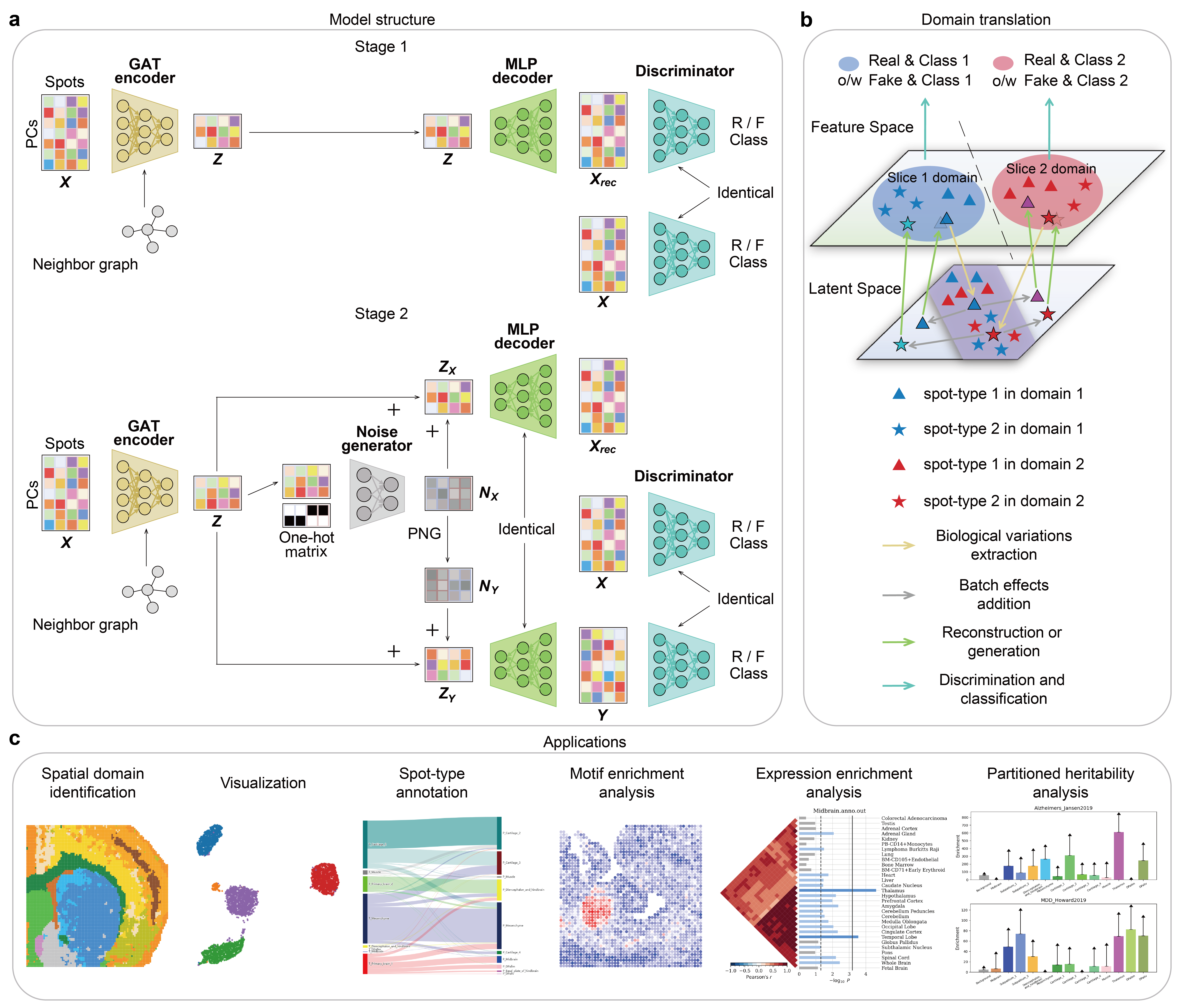
Recent advances in spatial epigenomic techniques have given rise to spatial assay for transposase-accessible chromatin sequencing (spATAC-seq) data, enabling the characterization of epigenomic heterogeneity and spatial information simultaneously. Integrative analysis of multiple spATAC-seq samples, for which no method has been developed, allows for effective identification and elimination of unwanted non-biological factors within the data, enabling comprehensive exploration of tissue structures and providing a more complete epigenomic landscape that facilitates the discovery of biological implications and aids in the study of regulatory processes. In this article, we present INSTINCT, a method for multi-sample INtegration of Spatial chromaTIN accessibility sequencing data via stochastiC domain Translation. INSTINCT can efficiently handle the high dimensionality of spATAC-seq data and effectively eliminate the complex noise and batch effects of samples from different conditions through a stochastic domain translation procedure. We demonstrate the superiority and robustness of INSTINCT in integrating spATAC-seq data across multiple simulated scenarios and real datasets. Additionally, we highlight the advantages of INSTINCT in spatial domain identification, visualization, spot-type annotation, and various downstream analyses, including expression enrichment analysis and partitioned heritability analysis.
Citation
Yuyao Liu, Zhen Li, Xiaoyang Chen, Xuejian Cui, Zijing Gao and Rui Jiang. “INSTINCT: Multi-sample integration of spatial chromatin accessibility sequencing data via stochastic domain translation.” Preprint at bioRxiv https://doi.org/10.1101/2024.05.26.595944 (2024).